
Integrative Therapeutic Bodywork
Over 40 Years of Listening to the Body
After more than 40 years of practicing therapeutic bodywork, my work has evolved into an integrative approach that brings together specific injury and rehabilitation work, fascial work, movement, nervous-system support, and somatic awareness.
I offer a limited number of private sessions for people who appreciate specific, individualized bodywork—work that begins with what your body is presenting rather than following a predetermined full-body routine.
You may come in with an injury, limited range of motion, persistent tension, an old pattern that keeps returning, or simply the feeling that something in your body isn't moving or feeling quite right.
I especially enjoy working with patterns that arise from the ways we live and move—sports, hiking, biking, repetitive activity, sitting at a desk, stress, and overuse.
Assessment + Deep Listening
When there is a specific injury or movement restriction, I may begin by assessing range of motion and how your body is moving.
My training in the NeuroFascial Flow® Method with my daughter, Dr. Satya Sardonicus, has added another dimension to the way I assess the relationship between movement, fascia, and the nervous system.
After hands-on work or a specific movement or fascial exercise, we may reassess and notice together what has changed. Has your range increased? Does the movement feel easier? Has the original restriction shifted or revealed another area asking for attention?
I love this meeting place between specific assessment and intuitive listening.
The assessment gives us one kind of information. My hands give me another. And your body ultimately helps show us where to go next.
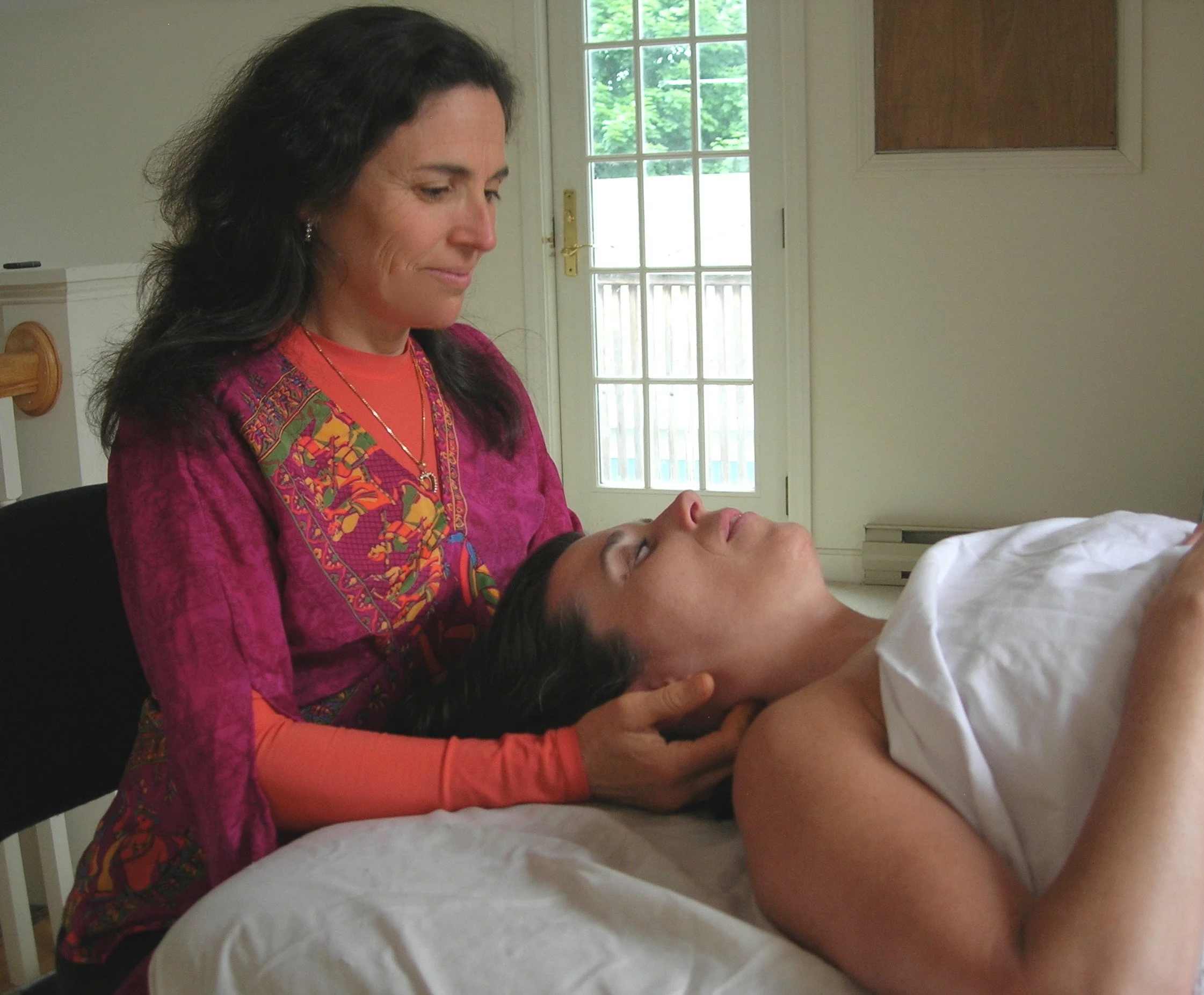
Working With Fascia
Fascia is the interconnected connective-tissue network that surrounds, supports, and connects structures throughout the body. Because of this interconnectedness, the place where you experience discomfort isn't always the only place asking for attention.
My fascial work uses gentle, attentive contact to listen for subtle patterns of tension and movement within the tissues. Rather than forcing a release, I follow what I feel, allowing the tissues an opportunity to unwind and reorganize.
It is subtle work that requires patience, sensitivity, and deep listening through the hands.
Movement, Embodiment + Listening
Movement has been part of my life for more than 50 years. My experience with dance, Contact Improvisation, and 25 years of teaching yoga has profoundly shaped the way I understand and listen to the body.
Contact Improvisation, in particular, has deepened my sensitivity to weight, movement, connection, and subtle shifts within the tissues. There is a quality of listening through the whole body—following rather than directing—that also lives at the heart of my hands-on work.
More recently, I've been exploring the meeting place between Contact Improvisation and bodywork with experienced Contact dancers. Through supported movement and full-body contact, I listen for subtle patterns of tension and follow the body's natural impulses toward movement and unwinding.
It is a fluid and collaborative exploration—bodywork not only through the hands, but through movement, weight, presence, and whole-body listening.
For clients who already practice Contact Improvisation and are curious about this dimension of the work, we can discuss whether it would be appropriate to incorporate into a session.
An Integrated Approach
Depending upon what your body needs, I may draw from Specific Muscle Rehabilitation, trigger point work, applied kinesiology and muscle testing, Craniosacral Therapy, visceral work, acupressure and meridian work, NeuroFascial Flow® principles, breathwork, therapeutic stretching, movement, and somatic awareness.
My training in Somatic Embodiment and Hakomi brings another dimension to the work. Sometimes persistent physical holding has a relationship with stress, emotion, or protective patterns. When appropriate and welcomed, we can gently include this layer through body awareness, breath, movement, or mindful inquiry.
After more than four decades, I don't experience these as separate techniques. They have become an integrated language through which I work with the body.
I listen, assess, and follow.
The Quality of Touch
For me, touch is a form of listening.
Over more than 40 years of working with the body, my hands have developed a sensitivity that allows me to listen beneath the surface—to notice subtle shifts in tissue, tension, breath, and the nervous system.
Whether we're addressing an injury, improving movement, working with fascia, or simply helping your body settle, the quality of touch matters. My intention is not to impose change, but to meet and support the body in a way that allows it to soften, reorganize, and find greater ease.
You don't need to know which technique you need before you arrive.
Come with what you're noticing. We'll begin there and listen together.
Sessions
Private sessions are available in Boulder, with locations in South Boulder and Gunbarrel/North Boulder.
60 minutes — $120
90 minutes — $180
If you're coming in with a specific injury, movement restriction, or more complex pattern, a 90-minute session can give us additional time for assessment, hands-on work, and reassessment.